

One of a kind. That’s what you are and that’s what you want your violin to be, right? Trust me, I get it.
You want to project a commanding persona and you want your violin to be an extension of your own unique personality.
Here’s where I can help. There are several ways in which we can make our instrument our own.
I’m going to detail some select areas where you can spiff up your fiddle and show some flare.
However, there is a disclaimer: some of these changes are too difficult for a beginner to make on their own.
In some cases you’re going to need a luthier to take the modification pieces and apply them.
Some assembly required

If what you want to change requires changing strings or removing components that hold the strings, immediately stop and assess what it is you want to do.
For example, if you’re just changing strings, only change 2 strings at a time at most.
This is so that there is still some tension left on your bridge to hold your internal sound post in place.
This is important. If your sound post moves even a centimeter, it can change the entire sound of your violin.
For better or worse, stick to changing only two strings at a time.
If changing a particular component requires you to remove all of the strings, and then remove said component, that’s a job for a luthier.
Never be afraid to find a violin shop and have them make the changes. Sure, it might cost a little extra money.
But you’re going to make sure you don’t permanently damage your instrument which would make both of us sad.
Custom violins

There is absolutely the option to have a custom violin built.
There are some online vendors who will semi-customize your violin for you. We talked about one in our electric violin review article here.
However, most acoustic violins that you have built for yourself will run you a pretty penny.
Normally this translates into thousands of dollars.
Feel free to entertain the idea of a custom built violin.
However, for our purposes, we’re going to aim this article at a violin you already have.
Having said that, let’s go ahead and dive in to things you can do on your own
Violin string changes

Changing your strings is the first way to customize your instrument. Some strings have metal plating that gives a distinct look.
Others have specific colors for the thread wrapping on the base and the tip of the strings. You may desire one color over another.
Feel free to experiment with strings, but I wouldn’t advise choosing a string just because you like the thread design on each end.
One of the best ways to customize your violin is to customize yourself and that means sounding good while playing. This is where you can find the right strings for you.
Check out our article on how to buy violin strings to find the best one for you.
Violin pegs
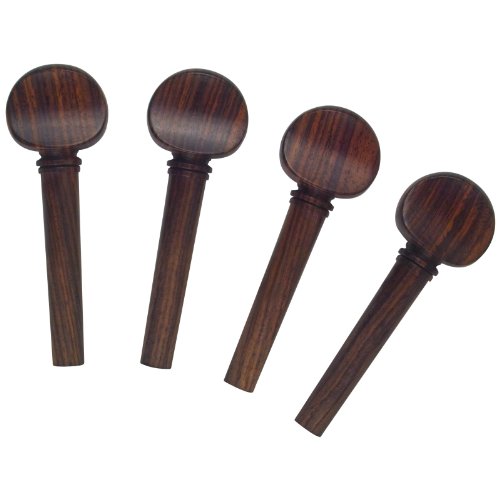
The pegs sit in the peg box just below the scroll. They hold the strings in place.
Some inexpensive violins come with cheap wooden pegs that are painted black.
Or even worse, they will ship with plastic pegs (not to be confused with Perfection mechanical pegs. Those are actually nice).
My favorite pegs are the ones with either inlays or carvings.
It’s more ornate and much more beautiful. Inlay materials include mother of pearl and precious metals like gold or silver.
Carvings can be literally anything. Find what you like best.
There are several different kinds of wood used in making real wood pegs. The most common is ebony.
The other two most common wood materials are boxwood and rosewood. Any of these three will serve you well, but I personally prefer ebony for my instrument.
However, on the right violin, a lighter wood can be exquisite.
Here’s a few options for you in case you’d like to upgrade your string holders.
Anton Breton Rosewood Violin Pegs-Set of 4
Ammoon Ebony Violin Pegs with Inlays-Set of 4 with Button
SKY Carved Violin Pegs with Button-Set of 4 available in Rosewood or Ebony
Tailpiece on the violin

The tailpiece holds the ball or loop end of the strings below the bridge.
It’s attached to the button which is on the lower bout of the violin. The tailpiece is one of those things that you want to have a luthier change.
The tailpiece can have inlays, it can be carved, or it can even be painted.
I don’t suggest buying any components for the violin that are painted, but if you’re going to do it, the tailpiece is the most reasonable place for this.
The tailpiece, like the pegs, is primarily made of three materials: ebony, boxwood, and rosewood.
Since we’re speaking strictly of cosmetics, we’re going to choose the material that best accompanies the color and look of our instrument.
This can be contrasting the color of the violin or trying to match it. Either way is your choice.
Here’s a few examples of tailpieces that could really make your violin look sharp.
Dimitri Alexi Ebony Hill style tailpiece with ebony saddle
Sky Ebony tailpiece with carved dragon pattern
WBO Ebony Harp Style Tailpiece
The violin button

The button, also known as the “endpin”, holds the tailpiece in place and is located on the lower bout of the violin.
It is set into the body of the violin. As such, this is another component that you want a luthier to change for you.
Again we have the three wood materials as options for button composition: ebony, rosewood, and boxwood.
The button is primarily simple or has inlays on it. There aren’t many carved buttons but it’s not outside of the realm of possibility if you know a luthier who is willing to make one for you.
Here are a few good options for button swapping.
Anton Breton Ebony Violin Button
Dimitri Alexi ebony endpin/button with bone collar and pin
Dimitri Alexi Rosewood endpin/button
Chin rest on your violin
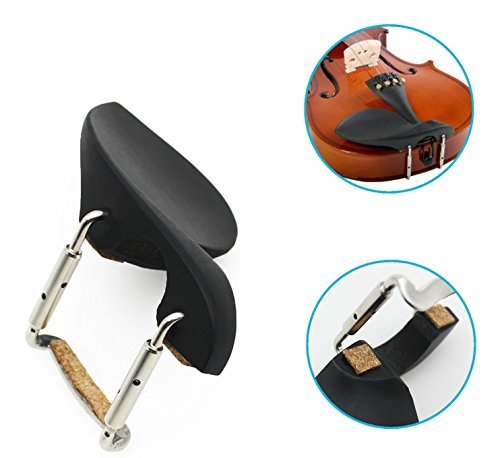
The chin rest is a slightly different animal.
It is highly functional in that if you have an uncomfortable chin rest, you’re not going to want to play the violin as much.
It just won’t be as much fun. So remember this when looking to change or upgrade this specific component of the violin.
There are a lot of different designs for the chin rest.
The difficult part is finding the one that will satisfy you visually and be comfortable.
The only real answer to this is to try a few.
However, make sure you are always holding your violin properly and that will go a long way to helping you play more easily.
My one piece of advice is to not get a chin rest that is too small.
If it’s a sliver, it is far less likely to be comfortable. I’d rather play on a cloth than on a tiny chin rest.
However, that’s just my opinion. Conversely, you don’t want a behemoth of a chin rest either.
It’s a very personal thing to get a good chin rest as your body dimensions come in to play.
With that in mind, here’s a few ideas if you’re looking to upgrade your chin rest.
Conrad Gotz original ebony chin rest 4/4 size
Violin Woodworkshop Guarneri rosewood chin rest 4/4 size
JSI Dresden ebony violin chinrest 4/4 size
Violin bridge

The bridge can be a major factor when upgrading your violin.
Some bridges are darker than others, some are lighter. Some are wider in dimensions than others while some are thin.
Bridges tend to work best with a violin they’re made for, so when you buy a bridge, have a luthier cut and tailor your bridge’s height and string notches to specifically fit your violin.
However, I’ll tell you what I prefer. I prefer a thinner bridge with smaller feet.
This seems counter intuitive since there is a lot of tension being placed on the bridge via the strings.
However, in my experience, the wider the bridge, the lower the quality of the bridge itself and the sound it produces.
A key tip would be to visually check and see if the bridge looks “fuzzy”. If so, I’d suggest you keep looking at other bridges.
A good bridge will transfer the vibrations of the strings uninhibited to the violin.
We will talk more about this in another article specifically aimed at improving the sound of your violin.
For now, don’t skimp too much on the bridge, but find one that is made of good quality maple that has the look you desire.
Here’s a few examples of some bridges that might fit your specifications.
Aubert Teller Semi Fitted Violin Bridge
SKY High Quality Fitted 4/4 Full Size Violin Maple Bridge
Aubert 9142-44 Teller Germany V Insert Semi Fitted Violin Bridge
Fine tuners on your violin
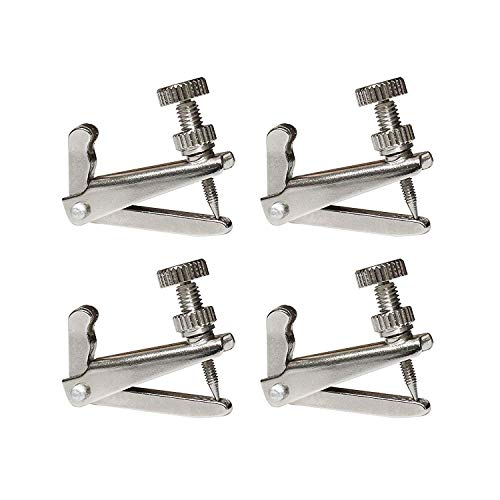
Fine tuners make small adjustments to the tuning of the strings while pegs make large tuning adjustments.
Fine tuners are located on the tailpiece and they will hold the ball or loop end of the strings instead of said ends threading directly to the tailpiece.
Fine tuners can be built in to the tailpiece or sit separately in holes for tailpieces that don’t have them built in.
Fine tuners that are built into the tailpiece cannot be upgraded and if they break, you have to replace the tailpiece.
This is why I suggest using a tailpiece that does not have built in fine tuners.
Fine tuners can come in different colors as well. The main colors are silver and gold but they also come in black or a combination of the two.
It’s entirely up to you on what color you’re looking for.
Most people use black or silver. But on the right violin, like a very dark wood violin, gold can absolutely pop and make for a very gilded, opulent aesthetic.
Here’s some options if you’re in the market for some fine tuners.
Vio Music 4 Full-size 3/4, 4/4 Violin Fine Tuners, Black
Mi&Vi stainless steel adjustable fine tuner set 4/4 size
Sky 4 piece Violin Fine Tuner 3/4 -4/4 Gold Violin Parts Accessories
Violin Fitting Sets
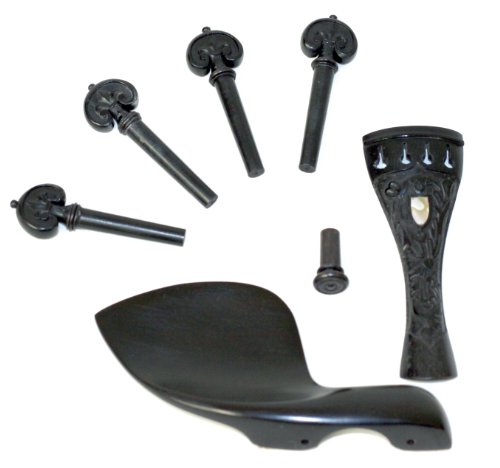
These sets will contain pegs, a button, a chin rest, and a tailpiece.
So all things considered, they won’t have every single thing you could use to upgrade your instrument.
However, it’s a great start to your violin renovations. Check them out and see if they tickle your fancy.
Sky Carved Rosewood Violin Fittings Pegs/Tailpiece/Chinrest/Endpin
Final thoughts
This article is aimed at helping you improve the cosmetics of your instrument.
If you have a violin that you like but wish it had a little “pop” to it, maybe one of these ideas will be the change you’re looking for.
Always be careful and don’t change a part of the violin that requires you to remove all the strings unless you are an experienced violin technician or you don’t mind if the instrument gets damaged.
I hope this helps everyone and best of luck tricking out your fiddle!